










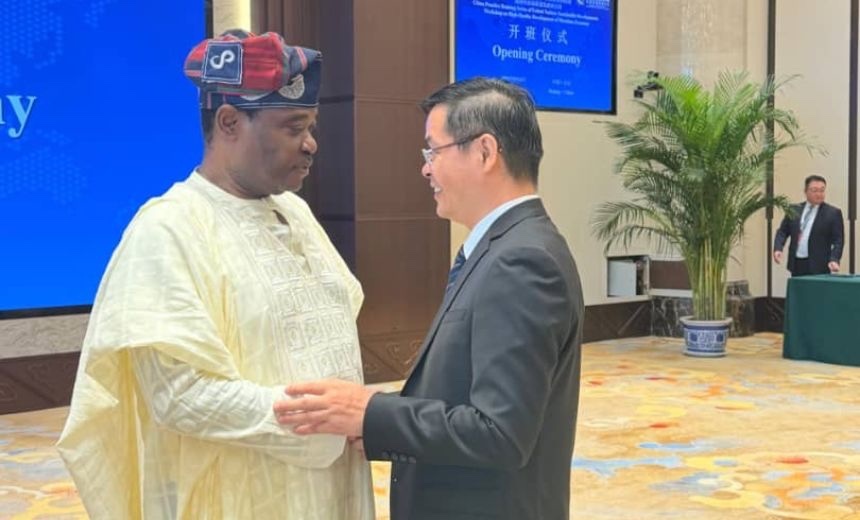
Nigeria has extended an invitation to the People’s Republic of China to partner with the country through the deployment and exchange of geophysical data across its nautical domain as part of efforts to unlock the enormous potential of the blue economy.
The proposal, which places emphasis on strategic partnership, technology transfer and data-driven collaboration rather than conventional development assistance, was disclosed by Nigeria’s Permanent Mission to the United Nations.
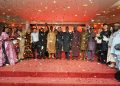
The Mission made the disclosure in a statement issued on Tuesday by the Office of Nigeria’s Permanent Representative to the United Nations in New York following a keynote address delivered by Nigeria’s Permanent Representative to the UN, Ambassador Jimoh Ibrahim, at the United Nations Sustainable Development Workshop on High-quality Development of the Marine Economy in Beijing, China.
Representing President Bola Ahmed Tinubu at the international workshop, Ambassador Ibrahim said the administration’s vision is to harness geophysical intelligence, marine research and innovation to drive sustainable economic growth and position Nigeria among the world’s leading blue economy nations.
According to him, President Tinubu’s invitation to China is anchored on the conviction that access to geophysical and oceanographic data will deliver far greater long-term economic value than dependence on foreign aid.
“President Bola Tinubu is offering China an open invitation for partnership through geophysical data and innovation rather than aid. The future prosperity of nations lies in harnessing the immense wealth of the oceans through knowledge, technology and strategic cooperation,” Ibrahim stated.
He praised China for its leadership in advancing the global blue economy and reaffirmed Nigeria’s commitment to deepening bilateral and multilateral cooperation in maritime development.
The envoy noted that the creation of the Federal Ministry of Marine and Blue Economy by the Tinubu administration demonstrates Nigeria’s resolve to maximise the economic opportunities embedded in its vast maritime resources.
He stressed that the ministry represents a strategic step towards transforming the country’s marine assets into engines of economic diversification, job creation and sustainable national development.
Ambassador Ibrahim also urged the international community to embrace innovation, artificial intelligence, sustainable financing and stronger global partnerships to unlock the full potential of the marine economy.
He further advocated the development of innovative financing mechanisms to assist developing countries in building resilient blue economy infrastructure while promoting sustainable ocean governance.
Reaffirming Nigeria’s readiness to collaborate with China and other international partners, Ibrahim said the country remains committed to advancing a prosperous, inclusive and sustainable global marine economy.