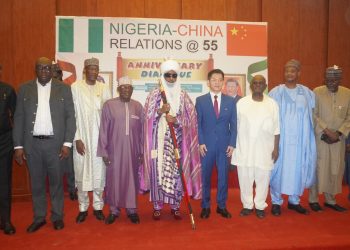

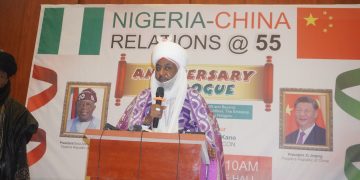
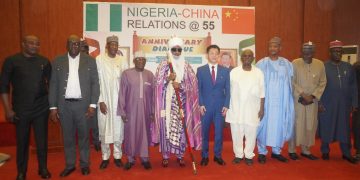








The Emir of Kano, Muhammadu Sanusi II, has called for a strategic recalibration of Nigeria’s economic engagement with China, urging policymakers to prioritise industrialisation, manufacturing and long-term competitiveness as both countries mark 55 years of diplomatic relations.
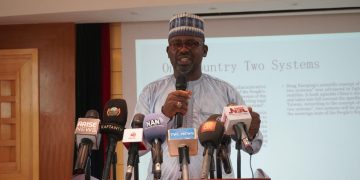
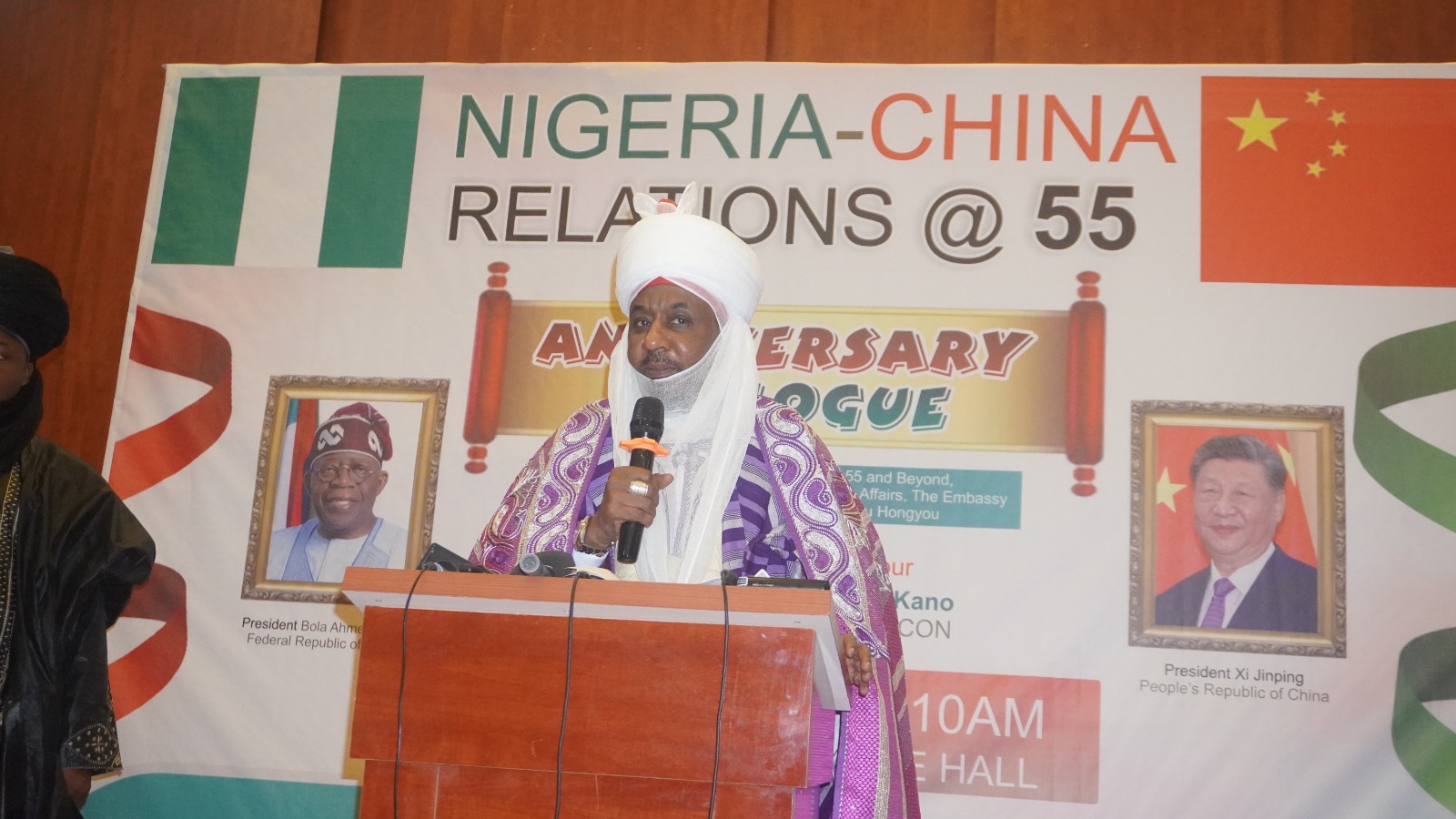
Sanusi made the remarks at the “Nigeria/China at 55 and Beyond” Dialogue held in Abuja on Wednesday. The event was organised by the Centre for China Studies in collaboration with the Institute for Peace and Conflict Resolution (IPCR). It drew embassy officials, government representatives, diplomats, academics and students.
In his remarks, the emir extended New Year greetings to the Chinese community and reflected how is late father, Ambassador Aminu Sanusi, served as Nigeria’s first ambassador to China in the early 1970s.
Recounting his father’s posting to Beijing in 1971, Sanusi described China at the time as a country still grappling with widespread poverty and emerging from the Cultural Revolution. He contrasted that era with China’s rapid transformation over the past five decades, citing the country’s dramatic poverty reduction and expansion of higher education as evidence of strategic long-term planning.
“China has shown what is possible in 40 to 50 years with focus and clarity of purpose,” he said, noting that hundreds of millions of people were lifted out of poverty within a generation.
Sanusi also reflected on his tenure as Governor of the Central Bank of Nigeria, when Nigeria became one of the first African countries to include the Chinese renminbi (RMB) in its foreign reserves. At the time, he argued that China’s growing role in global trade and production made the currency’s internationalisation inevitable.
He said diversifying reserves and reducing overdependence on a single global currency was part of a broader strategy to reposition Nigeria within an evolving global economic order.
Turning to current economic realities, the Emir stressed that while Chinese investments in infrastructure , including roads, railways and airports, are welcome, Nigeria must move beyond being primarily a consumer market.
“What we want more than anything else is factories. Come and build production facilities, employ our people, produce goods here and export from here. That is the real win-win,” Sanusi said.
He expressed concern that Nigeria risks missing out on opportunities as Chinese manufacturers relocate lower-value industries abroad due to rising labour costs at home. According to him, countries such as Ethiopia and Ghana have attracted significant Chinese manufacturing investments, while Nigeria , despite its large market size , has not fully leveraged its potential.
Sanusi warned that without a clear industrial strategy, Nigeria could remain dependent on imports, even within Africa. He noted that with the African Continental Free Trade Area (AfCFTA) in place, countries like Benin and Ghana could emerge as manufacturing hubs for goods ultimately destined for Nigerian consumers.
“We should be the hub for manufacturing and production in West Africa,” he said, arguing that Nigeria’s population and market size give it a natural advantage that must be backed by deliberate policy and diplomatic engagement.
The Emir described Nigeria–China relations as “work in progress” and characterised aspects of the partnership as “unfinished business,” borrowing a phrase he said his father once used in discussing foreign policy.
He also situated the bilateral relationship within a broader global context, referencing shifting geopolitical dynamics and what he described as a period of uncertainty in international affairs. In this environment, he said, Nigeria must think strategically about its alliances and economic positioning.
Despite his criticisms, Sanusi reiterated his belief in the potential of Nigeria–China cooperation, emphasising that both countries can benefit from deeper, production-focused collaboration.
He urged Nigerian diplomats and policymakers to adopt a forward-looking approach, identifying global trends early and positioning the country to take advantage of emerging opportunities.
Speaking on behalf of the Chinese Ambassador to Nigeria, Chargé d’Affaires Zhou Hongyou reaffirmed China’s commitment to deepening ties with Nigeria. He recalled that diplomatic relations were established on February 10, 1971, and have since evolved from a basic diplomatic partnership to a Comprehensive Strategic Partnership.
Zhou said China has consistently supported Nigeria’s efforts to maintain national unity, peace and stability, while Nigeria has upheld the one-China principle and supported China on core issues. He noted that cooperation has expanded across trade, infrastructure, energy, mining, health and education.
Highlighting key projects such as the Lekki Deep Sea Port, Zungeru Hydropower Station, the Ajaokuta–Kaduna–Kano (AKK) Gas Pipeline and railway modernisation initiatives, Zhou said bilateral trade has grown significantly, reflecting the dynamism of the partnership.
He outlined four priority areas for the next phase of engagement: strengthening strategic mutual trust, advancing high-quality Belt and Road cooperation aligned with Nigeria’s development agenda, enhancing coordination in multilateral institutions such as the United Nations and BRICS, and expanding people-to-people exchanges in education, culture, youth and media.