









Chinese Foreign Minister Wang Yi has urged the international community to place development back at the heart of global cooperation, warning that widening inequalities and slowing progress toward the Sustainable Development Goals (SDGs) require stronger international solidarity and renewed multilateral action.
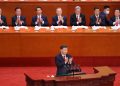
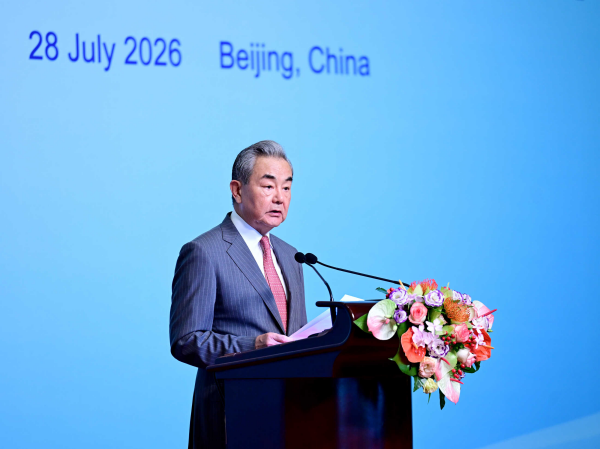
Speaking at the High-Level Meeting on the Global Development Initiative (GDI), jointly organised by China and United Nations agencies, Wang said the initiative has become an increasingly important platform for addressing development challenges since it was proposed by President Xi Jinping at the United Nations General Assembly in 2021.
He said the initiative has transformed from a Chinese proposal into a global partnership that now enjoys broad international support and is helping countries pursue the objectives of the UN’s 2030 Agenda for Sustainable Development.
According to Wang, more than 130 countries and international organisations have endorsed or participated in GDI cooperation, while close to 100 countries and regional organisations have formalised cooperation with China under the initiative.
“The philosophy of prioritising development has gained wider recognition, and international cooperation on development has gathered stronger momentum,” he said.
The foreign minister noted that China has continued to promote dialogue on global development by hosting high-level meetings during successive sessions of the United Nations General Assembly and establishing the Forum on Global Action for Shared Development.
He said institutional support for the initiative has also expanded significantly. The Group of Friends of the Global Development Initiative now comprises 88 countries, while more than 20 UN development agencies are participating in a dedicated task force established to advance implementation of the 2030 Agenda.
Beyond policy discussions, Wang highlighted what he described as measurable development achievements. China, he said, has mobilised more than US$23 billion through various international development funds to support over 1,800 grassroots development projects and train more than 200,000 professionals in developing countries.
The projects, he explained, range from agricultural technologies designed to reduce poverty to satellite-based scientific cooperation and digital platforms that improve weather forecasting, disaster preparedness and climate resilience across the Global South.
Despite those gains, Wang cautioned that global development continues to face serious setbacks.
He pointed to increasing geopolitical tensions, widening development gaps between developed and developing countries and the slow implementation of the SDGs as evidence that stronger international cooperation is urgently needed.
To address these challenges, Wang outlined four priorities that he believes should guide future global development efforts.
The first, he said, is maintaining peace and stability by strengthening international solidarity and supporting the central role of the United Nations in global governance.
Secondly, he called for greater investment in sustainable development through increased financial resources, technology transfer and broader cooperation among countries to accelerate progress toward achieving the SDGs.
Wang also stressed the importance of innovation, urging countries to work together to narrow the digital and artificial intelligence divide. He cited the recent establishment of the World Artificial Intelligence Cooperation Organization (WAICO) as an example of efforts to promote inclusive AI development and governance, particularly for developing countries.
Finally, he advocated reforms to the global economic and financial system, including stronger international cooperation on development financing and greater representation for developing countries as discussions begin on shaping the global development agenda beyond 2030.
Turning to China’s own development, Wang said the country remains committed to serving as a driver of global economic growth despite external challenges.
He noted that China’s economy expanded by 4.7 per cent during the first half of 2026, maintaining steady growth even amid global energy pressures and disruptions to international supply chains.
According to him, China’s continued economic stability provides confidence for the international community at a time of growing uncertainty.
He reaffirmed Beijing’s commitment to advancing the Global Development Initiative, expanding cooperation with partners worldwide and supporting shared prosperity through practical development programmes.
Wang said China would continue aligning its own development with global progress and work with other nations to build a more inclusive, balanced and sustainable future.