














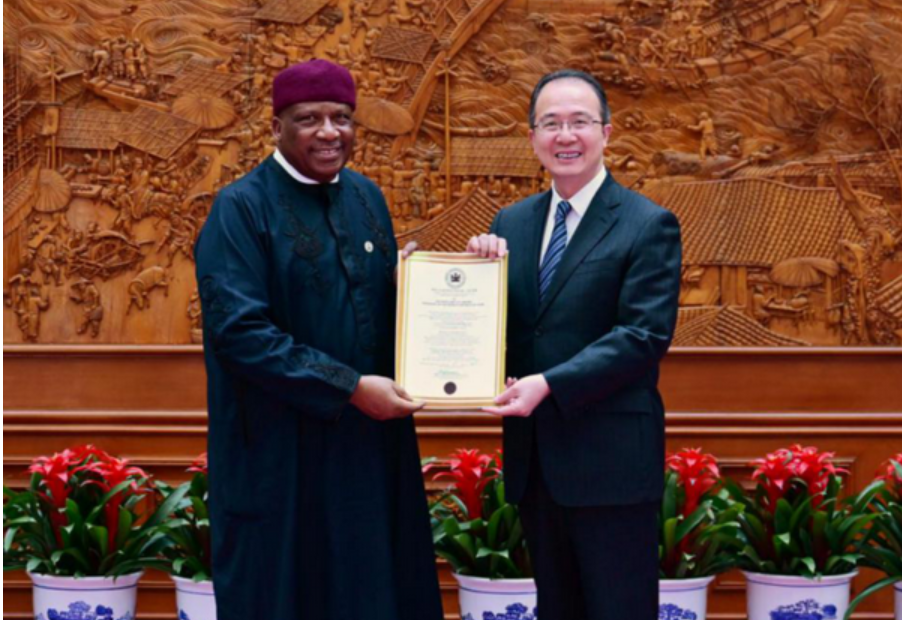
Nigeria’s newly appointed Ambassador to the People’s Republic of China, Lt.-Gen. Abdulrahman Bello Dambazau (rtd), has formally commenced diplomatic duties in Beijing following the presentation of copies of his credentials to China’s Assistant Foreign Minister and Director-General of the Protocol Department, Hong Lei.
The presentation of credentials marks a significant diplomatic milestone, officially enabling the ambassador to begin representing Nigeria and engaging with Chinese government institutions in his host country.
Dambazau, a former Chief of Army Staff and Minister of Interior, was appointed by President Bola Ahmed Tinubu earlier this year as Nigeria’s envoy to China, one of the country’s most important strategic and economic partners.
His assumption of office comes at a time when relations between Abuja and Beijing continue to expand across a broad range of sectors, including trade, infrastructure development, technology, education, security cooperation and cultural exchange.
Over the years, China has emerged as one of Nigeria’s largest trading partners. Bilateral trade between both countries surpassed $28 billion in 2025, representing a 30.2 per cent increase over the previous year. Chinese exports to Nigeria reached approximately $24.9 billion during the period, driven largely by demand for machinery, electronics and industrial equipment.
Beyond trade, China has played a major role in supporting Nigeria’s infrastructure development through financing and technical cooperation aimed at accelerating economic growth and industrialisation.
Several landmark projects across the country have benefited from Chinese funding and expertise. These include the $1.5 billion Lekki Deep Sea Port, railway modernisation projects, the construction of new terminal buildings at the Abuja, Kano, Port Harcourt, Enugu and Lagos international airports, as well as the expansion and dualisation of the Abuja-Keffi Expressway and the Keffi-Akwanga-Lafia-Makurdi-Enugu road corridor.
Other major projects supported through China-Nigeria cooperation include the Zungeru Hydroelectric Power Station and the Greater Abuja Water Supply Project, both of which are considered critical to improving power generation and urban infrastructure in the country.
Analysts say Dambazau’s appointment comes at a pivotal moment in bilateral relations, as both countries seek to deepen cooperation under existing strategic partnership frameworks and explore new opportunities in investment, manufacturing, agriculture, digital technology and human capital development.
With extensive experience in public service, national security and governance, Dambazau is expected to play a key role in advancing Nigeria’s diplomatic and economic interests in China while strengthening ties between the two nations.
His mission is also expected to focus on expanding trade opportunities, attracting investment, promoting educational and cultural exchanges, and enhancing cooperation in areas that support Nigeria’s development priorities.
The commencement of his diplomatic assignment signals another step in the continuing evolution of China-Nigeria relations, which have grown steadily over the past five decades and remain among the most significant bilateral partnerships on the African continent.