










Joseph Tegbe, Director General and Global Liaison of the Nigeria-China Strategic Partnership (NCSP), says a $1 billion National Integrated Poultry Project will commence in Enugu, Kaduna and Oyo states as part of renewed Nigeria–China cooperation aimed at boosting food security, job creation and agro-industrial growth.
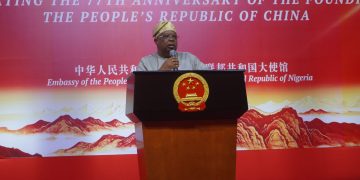
He disclosed this on Saturday while delivering a speech at the 2026 Chinese New Year Temple Fair held at the China Cultural Centre, Abuja, to celebrate the Year of the Horse and the 55th anniversary of diplomatic relations between Nigeria and China.
Tegbe said the pilot phase of the project, inspired by China’s success in agricultural productivity and food security, would later be expanded to other geopolitical zones across the country.
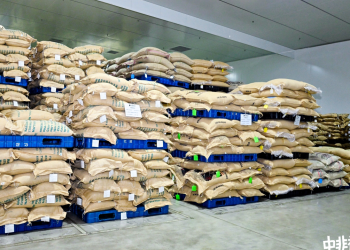
According to him, when completed, the integrated poultry initiative will produce six million eggs daily, house over seven million laying birds and more than two million broilers, while cultivating over 60,000 hectares of maize and soybeans to support feed production. He added that the programme would also provide subsidised feedstock to existing farmers, describing the initiative as a pathway not only to food sufficiency but to employment, dignity and economic opportunity for Nigerians.
Reaffirming Nigeria’s commitment to the One-China Principle, he described it as the foundation of the enduring friendship between both nations and a guiding pillar of their expanding cooperation.
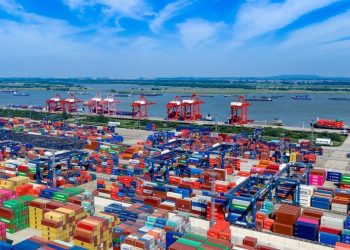
He highlighted key areas where Chinese partnership has contributed significantly to Nigeria’s development, including major infrastructure such as rail modernisation and the Lekki Deep Sea Port, which he said are reshaping the country’s economic landscape.
Tegbe also pointed to fresh momentum around the revitalisation of the Ajaokuta Steel Complex through collaboration with China.
“The revitalization of Ajaokuta Steel Complex marks another inspiring chapter in our partnership. Long a symbol of unrealized potential, Ajaokuta is now poised for renewal through collaboration with China. With an expected output of 10 million metric tonnes per annum, a revitalized Ajaokuta will transform Nigeria’s economic trajectory, powering industries, creating jobs, and positioning Nigeria as a leading manufacturing and innovation hub in Africa,” he said.
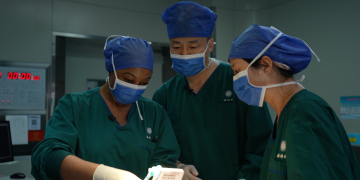
Tegbe also commended the growing knowledge exchange and educational partnerships between both countries, which are enabling Nigerian students to study in China while fostering academic collaboration and joint research. These efforts, he said, will support the establishment of new industrial parks driven by shared expertise, innovation and technology transfer.
He stressed that beyond trade and infrastructure, the Nigeria–China partnership must remain people-centred, encouraging Chinese businesses operating in Nigeria to prioritise skills transfer, local capacity building and inclusive growth.
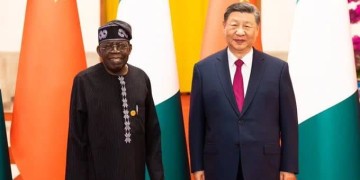
Tegbe expressed optimism that the coming year would witness measurable progress across these initiatives, inspired by the outcomes of President Bola Ahmed Tinubu’s visit to Beijing in September 2024 and the renewed commitment of both countries to deepen cooperation.
“As we celebrate the New Year, we must also look ahead with clarity of purpose. This is about projects that will define our shared future and deliver real impact to our people,” Tegbe said.
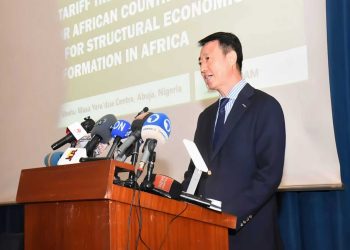
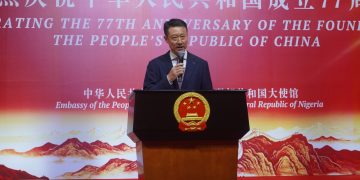
Earlier in his remarks, Chargé d’Affaires of the Chinese Embassy in Nigeria, Zhou Hongyou, described the Spring Festival as “the deepest cultural mark on the Chinese heart” and a moment of reunion for hundreds of millions of families across the world.
He noted that the festival, which will be celebrated globally on February 17, 2026, was inscribed on UNESCO’s Representative List of the Intangible Cultural Heritage of Humanity at the end of 2024, further affirming its global cultural significance and message of peace and harmony.
Zhou said the temple fair was designed not only as a celebration of culture but also as a platform for strengthening mutual understanding between the Chinese and Nigerian peoples through shared experiences in art, food, sports, and tradition.
He recalled that China and Nigeria formally established diplomatic relations on February 10, 1971, opening what he described as “a chapter of friendship across mountains and seas.”
Over the past 55 years, he said, the relationship has grown from political goodwill into wide-ranging cooperation spanning trade, infrastructure, education, science, and people-to-people exchanges.
“Over the past 55 years, regardless of changes in the international landscape, both sides have always upheld mutual respect, equality and win-win cooperation. From political mutual trust and economic cooperation to people-to-people exchanges, China–Nigeria relations have grown ever stronger and more fruitful,” he said.
Zhou described China–Nigeria cooperation as a model of South–South collaboration, noting that bilateral trade continues to expand while infrastructure partnerships remain steady. He revealed that both countries are also consulting on the implementation of zero-tariff measures to support Nigeria’s modernization efforts.
The envoy stated that 2026 holds special significance as it marks not only 55 years of diplomatic relations but also the “China–Africa Year of People-to-People Exchanges,” which he said presents an opportunity to deepen mutual understanding, enhance exchanges in governance experience, and broaden human connections beyond official engagements.
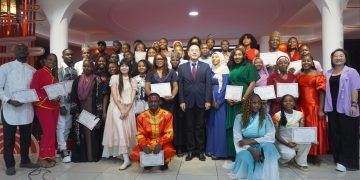
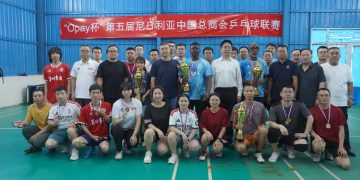
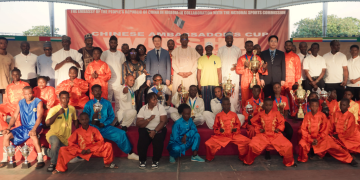
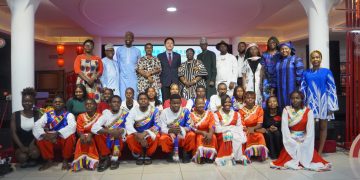
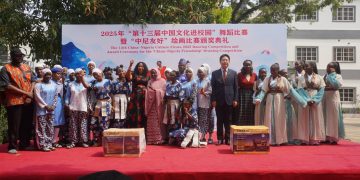
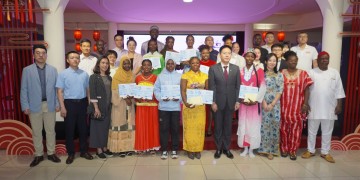
The celebration featured a vibrant showcase of cultural performances, musical acts, games and traditional Chinese delicacies.