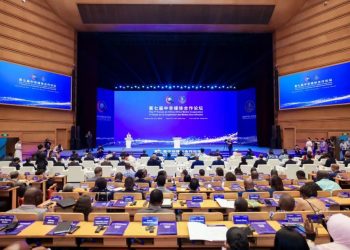
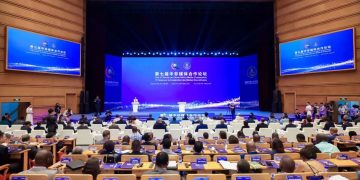
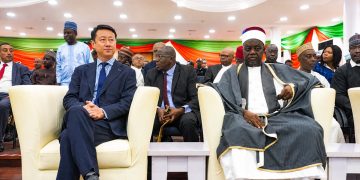










The 7th China-Africa Media Cooperation Forum has opened in Beijing, with African and Chinese officials, media executives, journalists and other stakeholders calling for stronger cooperation in broadcasting, audiovisual content production, digital technology and youth development.
The forum, themed “Share Development Opportunities, Shape the Audio-Visual Future,” brings together stakeholders from China and Africa to explore new opportunities for media cooperation and the use of technology to strengthen people-to-people exchanges.
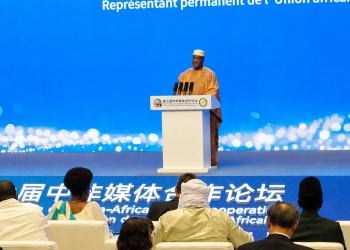
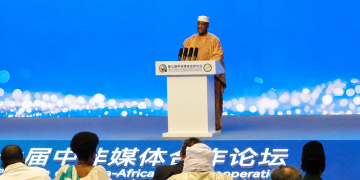
Speaking at the opening ceremony, the African Union’s Permanent Representative to China, Alhaji Mohamed Sarjoh Bah, said media and creative industries could play a strategic role in driving economic transformation across Africa.
Bah called for deeper Africa-China cooperation in film production, broadcasting, animation, gaming, digital content and other creative industries, saying the sector could create jobs, attract investment and stimulate innovation.
He also stressed the importance of ensuring that Africa tells its own stories, urging stronger partnerships between African and Chinese media organisations in content production and distribution.
According to him, Africa’s youthful population represents a major strategic advantage, requiring greater investment in skills development, professional exchanges, education and innovation.
Bah further called for responsible use of artificial intelligence and other emerging technologies, saying digital transformation should be inclusive, ethical and people-centred.
He urged the media to move beyond merely reporting Africa-China relations and become a force for development, solidarity, peace and stronger people-to-people understanding.
Gregoire Ndjaka, Director-General, African Union of Broadcasting, commended the forum for strengthening policy dialogue, professional exchanges and practical cooperation between Chinese and African broadcasters.
Ndjaka said China-Africa broadcasting cooperation had produced tangible results, particularly through Chinese technology, equipment and training that have supported the modernisation of African broadcasting.
He called for deeper cooperation in modern broadcasting technologies, lightweight production systems and professional training, noting that the AUB is preparing to establish a learning centre in Dakar, Senegal, aimed at strengthening broadcasting capacity across Africa.
Ndjaka also urged a more balanced flow of media content between China and Africa, calling for greater opportunities for African audiovisual programmes to reach Chinese audiences.
He said such cooperation would allow Chinese audiences to see Africa through African perspectives, while further strengthening mutual understanding and people-to-people ties. He stressed the growing importance of artificial intelligence and digital transformation in broadcasting and welcomed increasing China-Africa cooperation in applying AI to the media sector.
Ndjaka said the AUB was ready to work with Chinese broadcasters, production companies and technology partners to expand content distribution, professional exchanges and technological cooperation.
Also speaking at the forum, UN Under-Secretary-General and Special Adviser on Africa, Ahunna Eziakonwa, said the media had an important role to play in changing perceptions of Africa and promoting greater ownership of the continent’s narrative.
She described Africa as resource-rich, idea-rich and youthful, noting that by 2050, one in every four people globally would be African, with most of them under the age of 30.
Eziakonwa said Africa’s rapidly growing audiovisual sector, including Nollywood and emerging animation and film industries, represented a major opportunity for job creation, services trade and cultural exchange.
She called for African and Chinese broadcasters to move from simply transmitting content to co-creating it, while encouraging young filmmakers and media professionals from both sides to train and work together.
She also highlighted the potential of artificial intelligence to support content production in African languages and contexts, describing such cooperation as an investment in Africa’s narrative sovereignty and the aspirations of Agenda 2063.
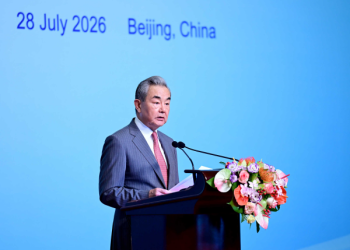
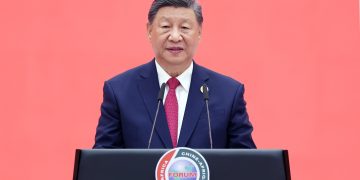
Delivering the keynote address, Cao Shumin, Deputy Head of the Publicity Department of the Communist Party of China Central Committee and Minister of the National Radio and Television Administration, called for stronger two-way media cooperation between China and Africa.
Cao said China-Africa media cooperation had developed over the years and contributed to strengthening people-to-people bonds through high-quality audiovisual content.
She called for greater two-way screening and content exchange, as well as increased attention to technological development and the application of emerging technologies in media production.
Cao said high-quality and more efficient media content would help consolidate China-Africa friendship and cooperation, urging broadcasters and content producers to build on existing partnerships.
She also called for expanded exchange programmes for media professionals, including journalists, producers, broadcasters and technicians, as well as regular mechanisms for professional cooperation.
Cao noted that China and Africa had already co-produced a number of audiovisual programmes and encouraged both sides to explore new opportunities, including the use of artificial intelligence in content generation, as part of efforts to pursue common development.
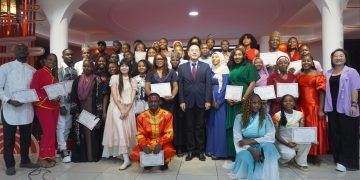
The forum, which runs from August 19 to 21, is also featuring the China-Africa Audio-Visual Programme Exchange, the China-Africa Audio-Visual Youth Cooperation Initiative and a China visit programme for African media practitioners.
The activities are expected to strengthen professional exchanges, encourage joint content production and deepen interactions among young media professionals from China and Africa.
The 7th China-Africa Media Cooperation Forum comes as cooperation between China and Africa continues to expand across various sectors, with participants seeking to harness the power of radio, television, audiovisual media and emerging technologies to strengthen friendship, support economic development and promote greater mutual understanding between the peoples of China and Africa.